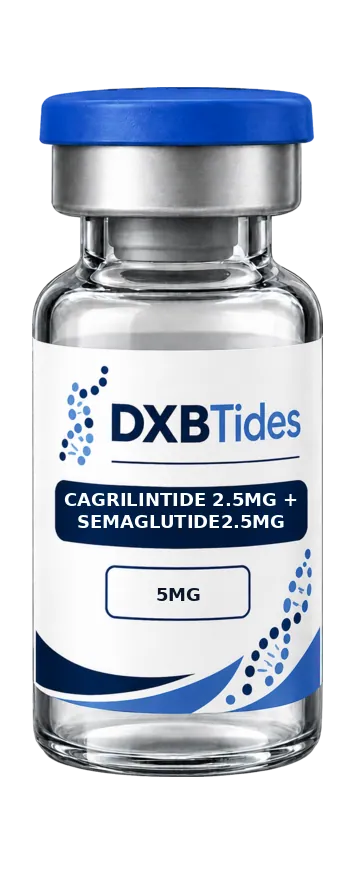
BLENDS / BLEND
CAGRILINTIDE + SEMAGLUTIDE
5MG · 10MGThis content is intended for educational and research reference only and does not constitute medical advice, diagnosis, or treatment. Experimental compounds are for research use only and are not for human consumption. Always consult qualified healthcare providers before starting any therapy.
Research Overview
A two-compound blend combining an amylin analog (cagrilintide) with a GLP-1 receptor agonist (semaglutide) at a 1:1 ratio, studied in appetite-signalling and weight-management research.
Available Strengths
- 5MG (CS5)
- 10MG (CS10)
Research Protocol
Reference titration (equal parts per peptide; volume reflects combined dose)
| Period | Dose | U-100 units | Volume |
|---|---|---|---|
| Weeks 1–4 | 0.5 mg | 15 | 0.15 mL |
| Weeks 5–8 | 1 mg | 30 | 0.3 mL |
| Weeks 9–12 | 2 mg | 60 | 0.6 mL |
| Weeks 13–16 | 3.4 mg | 102 | 1.02 mL |
| Weeks 17+ (maintenance) | 4.8 mg | 144 | 1.44 mL |
Reconstitution
≈3.33 mg/mL total blend once reconstituted (1.67 mg/mL each peptide)
- Draw 3.0 mL of bacteriostatic water per 10 mg vial.
- Inject slowly along the vial wall; swirl gently until dissolved.
Research context
Cagrilintide is reported to reduce appetite via central satiety pathways, while semaglutide activates GLP-1 receptors to enhance glucose-dependent insulin secretion and suppress glucagon; the source describes the combination as leveraging complementary mechanisms.
Storage
−20°C; protect from moisture. 2–8°C, use within 30 days; avoid freeze–thaw cycles.
Research Notes
- For educational and research reference only. Not medical advice and not intended for unsupervised human use.
- This is a proprietary two-compound blend; no approved human protocol exists and there are uncertainties around interactions and long-term safety for the combined product.
References
Source reference: PeptideDosages.com · 2026-08-18 · Exact strength match with the cited source