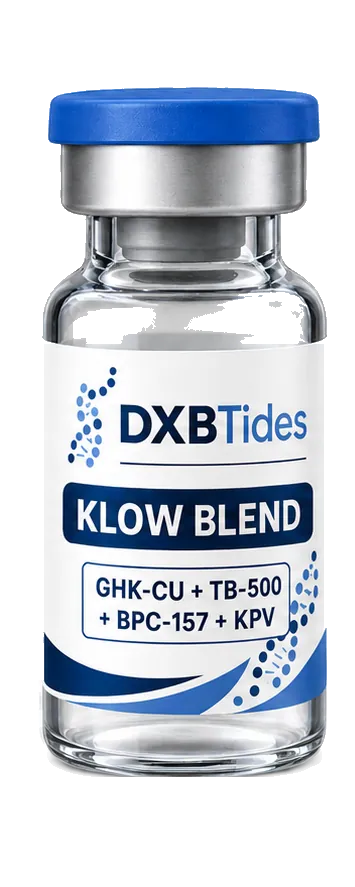
BLENDS / BLEND
KLOW
80MGThis content is intended for educational and research reference only and does not constitute medical advice, diagnosis, or treatment. Experimental compounds are for research use only and are not for human consumption. Always consult qualified healthcare providers before starting any therapy.
Research Overview
A four-component research blend combining TB-500, BPC-157, KPV and GHK-Cu, studied across tissue-repair, anti-inflammatory and skin-related research.
Available Strengths
- 80MG (KL80)
Research Protocol
Reference 8-week titration (TB-500 / BPC-157 / KPV amount shown per component; GHK-Cu scales with the same draw volume)
| Period | Dose | U-100 units | Volume |
|---|---|---|---|
| Weeks 1–2 | 0.25 mg | 7.5 | 0.075 mL |
| Weeks 3–4 | 0.5 mg | 15 | 0.15 mL |
| Weeks 5–8 | 0.75 mg | 22.5 | 0.225 mL |
| Weeks 9–12 (maintenance) | 0.5 mg | 15 | 0.15 mL |
Reconstitution
≈3.33 mg/mL for TB-500, BPC-157 and KPV; GHK-Cu sits at ≈16.7 mg/mL in the same 3.0 mL draw (26.7 mg/mL combined). The schedule below is keyed to the TB-500/BPC-157/KPV concentration — GHK-Cu scales with the same draw volume.
- Draw 3.0 mL of bacteriostatic water per 80 mg vial.
- Inject slowly along the vial wall; swirl gently until dissolved.
Research context
Component research discusses TB-500 in relation to cell migration and tissue repair, BPC-157 in tendon and muscle healing, KPV as an NF-κB signalling inhibitor with anti-inflammatory associations, and GHK-Cu in collagen and elastin synthesis. Component findings do not establish the safety or efficacy of the combined vial.
Storage
−20°C, minimize moisture exposure. 2–8°C, use within 14–28 days per the reference source, avoid freeze-thaw cycles.
Research Notes
- For educational and research reference only. Not medical advice and not intended for unsupervised human use.
- No approved human protocol exists for this proprietary blend; there are major uncertainties around interactions, systemic exposure and long-term safety for the combined product.
References
Source reference: PeptideDosages.com · 2026-08-18 · Exact strength match with the cited source